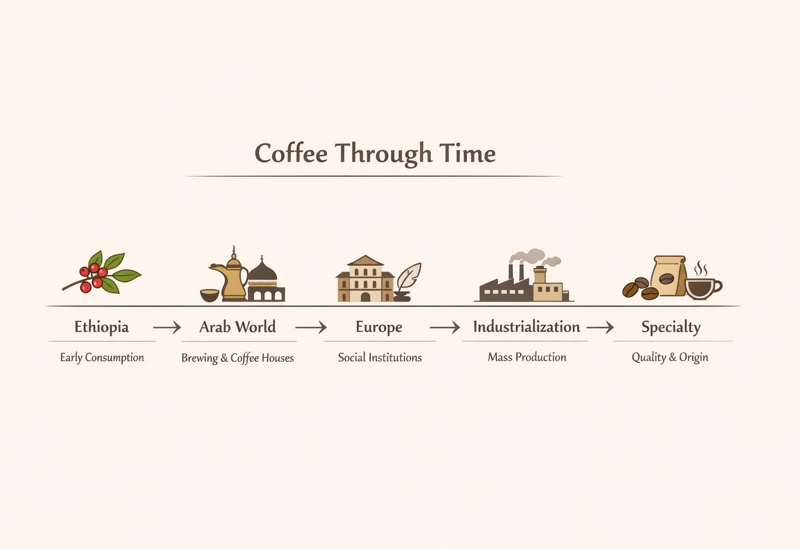
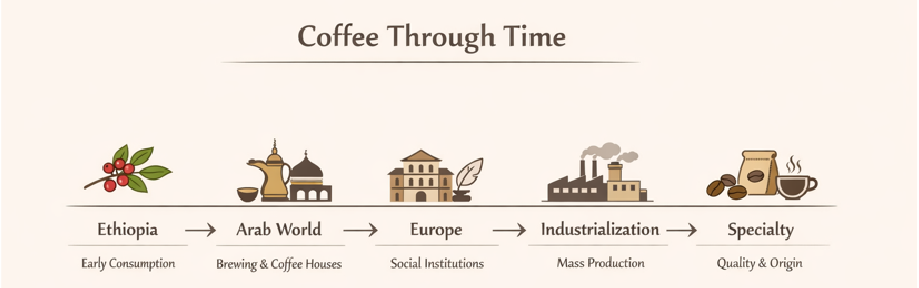
Most historical accounts place its origin in Ethiopia, where coffee cherries were likely consumed whole or fermented long before anyone roasted beans or brewed drinks. Coffee then travelled across the Red Sea into the Arabian Peninsula, where brewing as we recognise it today began to take shape.
By the 15th and 16th centuries, coffee had become embedded in social life across the Islamic world. Coffee houses appeared as places to talk, debate, listen, and think. Authorities occasionally tried to ban them. That usually didn’t work.
When coffee arrived in Europe in the 17th century, it was first treated with suspicion, then enthusiasm. Coffee houses spread rapidly. They became informal centres of trade, politics, science, and journalism. For the price of a cup, you could sit in a room full of people who disagreed loudly about everything. This was considered progress.
As demand grew, coffee followed colonial trade routes. Production expanded across Latin America, Africa, and Asia, often under unequal and extractive systems that still shape the industry today. Coffee became industrialised. Speed, volume, and shelf life mattered more than flavour or origin.
For much of the 20th century, coffee was treated as fuel. Consistency meant sameness. Quality meant not tasting bad.
What we now call specialty coffee emerged as a response. It reintroduced ideas that had been lost origin matters, processing matters, roasting matters, and people matter. This shift improved quality dramatically. It also added complexity, vocabulary, and rituals that not everyone wanted or needed.
Today, coffee sits somewhere between everyday habit and studied craft. It can be deeply explored or simply enjoyed. Historically, it has always been both.
That flexibility is not a weakness. It’s why coffee has lasted.


 English
  French