

Best coffee for a moka pot
The best coffee for a moka pot is freshly roasted, ground finer than for a V60 or a Chemex but coarser than for espresso, and needs no dark roast. At Heart of Coffee, choose the Espresso roast at Step 1 and Moka at Step 3, or order whole beans. For a chocolatey cup, start with Brazil Fazenda São Francisco.
Which roast for a moka pot?
Many moka pot guides recommend a dark, Italian-style roast. We don’t roast dark: there is no Italian-style roast in our range, and only some of our coffees go as far as medium-dark. A moka pot doesn’t need more: a very dark roast brings its own bitterness and masks the coffee’s flavours. Our Espresso roast is the natural match. A moka pot makes a short, strong coffee, more concentrated than filter but less than espresso: it brews at only 1 to 2 bar of pressure, against 9 bar for espresso. If you also make filter coffee, choose Omni when a coffee offers it: one roast that works for both espresso and pour-over. The three coffees suggested below come in Espresso, not in Omni.
Which grind for a moka pot?
Finer than for a V60 or a Chemex, but coarser than for espresso. Ground as fine as for espresso, the coffee chokes the pot: the water struggles through, the coffee over-extracts and tastes bitter. Too coarse, and the cup comes out thin and sour. On our coffee pages, choose “Yes” at Step 2 (Grind), then “Moka” at Step 3 (Grind type). Ground coffee is best enjoyed within 2 days: if you have a grinder, whole beans keep their aromas longer.
A simple moka pot recipe
For a 3-cup moka pot (three small cups of about 40 to 50 ml), fill the base with water just off the boil, up to just below the safety valve and never above it: about 130 to 150 ml. Fill the basket to the top with coffee ground for moka, about 15 g, and level it with a finger without pressing it down. The base is hot: hold it with a tea towel while you screw the pot together. Put it on medium heat with the lid open. As soon as the coffee starts to rise, turn the heat down so that it flows slowly and steadily; if it gushes out, take the pot off the heat. When the stream turns pale or you hear the first gurgle, take it off the heat and run the base under cold water to stop the brew. Serve straight away.
Hot or cold water in the base?
We suggest hot water, just off the boil. The pot comes up to pressure sooner, so the ground coffee spends less time heating on the stove before it brews, and the water reaches it hot enough to extract it properly; water at room temperature starts brewing well below the ideal temperature. The maker of the classic moka pot advises room-temperature water and low heat instead. That works too, but it is slower: if you start with cold water, keep the heat low.
Why does my moka coffee taste bitter?
Usually because it over-extracts. The common causes: heat that is too high, a pot left on the stove after it gurgles, a grind that is too fine, or coffee pressed down in the basket, which slows the water and draws out more bitterness. Start with hot water and medium heat, stop at the first gurgle, and never tamp. After each use, rinse the pot with water only, with no detergent and no dishwasher, as the maker of the classic moka pot advises, and check under the gasket: old coffee left there gives a stale taste. If the cup tastes thin and sour instead, grind a little finer (if you grind at home).
Which of our coffees for a moka pot?
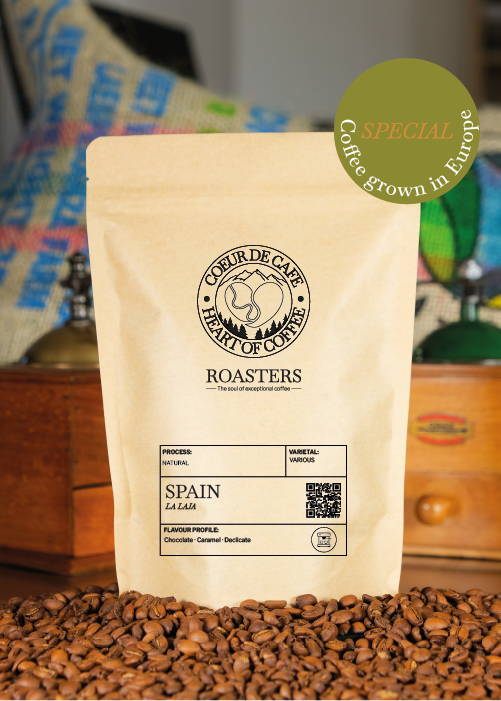
For a classic cup, round and chocolatey: Brazil Fazenda São Francisco (milk chocolate, roasted nuts, ripe plum, soft caramel), from €15.50. For a gentle cup with low acidity: Spain La Laja, grown on Gran Canaria, with gentle chocolate and light fruit, €12.50 for a 100 g bag. For more fruit: Ethiopia Djimmah, with berry and wine-like notes balanced by cocoa, from €15. Order all three in the Espresso roast, as whole beans or with the Moka grind.
In our shop: Espresso coffees · Omni coffees · Brazil Fazenda São Francisco · Spain La Laja · Ethiopia Djimmah
Read next: Best coffee for a French press, and how to brew it · Bitter or sour coffee: what’s the difference, and how to fix it? · Our brewing guide



 English
 French