



Borrowing Ideas Without Importing the Ego
I have spent most of my life in technology, which is a polite way of saying I have spent most of my life believing that if you instrument a system hard enough, it will eventually tell you the truth.
I have worked on high-performance computing: big machines, big constraints, big power bills. I have built data platforms and the plumbing underneath them. I have built AI models, deployed them, watched them behave like confident interns, and then scale the infrastructure so they could behave like adults. I have led teams that deliver under pressure, push boundaries, and occasionally discover that “just one more change” is how incidents are born.
I am also known for being… not humble. I mean, I am humble. But still the best. Obviously.
Then I walked into coffee with a blurry vision and a dangerous amount of confidence.
Because coffee looks, from far away, like a solvable system: inputs, transformations, outputs. Data matters. Platforms matter. Engineering matters. Coffee is complex, so surely we build a system and it becomes less complex.
Many moons later, coffee reminded me it is not just complex. It is alive. (Pun intended). It is agricultural. It is sensory. It is REALLY personal. And the most annoying part is this: there is not one right answer. There are many correct answers and everyone is right. There are more correct cups, many valid preferences, and many ways to get there. So this post is about how I am trying to transfer what I know from technology into coffee without turning coffee into a tech demo.
Principles travel, context does not
In tech, you copy patterns. In coffee, the “pattern” grew on a mountain and had feelings. You can not patch a bean. There is no rollback to “Harvest v1.2”. There is no recovery for a roasted batch that tastes flat and sits upset in a corner.
Coffee ships with built-in variability, like a feature nobody asked for, the hidden one that in software we call a bug.
So yes: bring systems thinking. Just don’t bring the illusion of control.
Translate the scoreboard (not to say KPIs)
Tech scoreboards are loud: latency, uptime, cost, accuracy, graphs that make you feel productive. Coffee scoreboards are quiet: “Do I want another cup?” and “Would I buy this again?”
Nobody ever said: “This espresso has excellent observability.”
If you optimise the wrong scoreboard, you’ll still hit your KPIs. You’ll just lose the customer. Politely. Forever.
Experiment, don’t evangelise
Tech loves belief. Coffee loves proof. You can not convince a cup with confidence and a slide deck. (I tried as someone once told me that I can convince a fountain to buy water).
Run small experiments. Taste blind. Measure. Repeat. If the result says you are wrong, you do not argue. You update.
Coffee is basically A/B testing with caffeine.
Build a shared language
In tech, schemas stop people from arguing about “what this field means.” In coffee, tasting notes stop people from arguing about “what this cup is.”
Without structure, you get debates like: “It is fruity.” “No, it is floral.” “It is… music.” So we standardise: methods, notes, definitions, data. Not to be fancy. To be able to learn without mythology.
Keep responsibility human
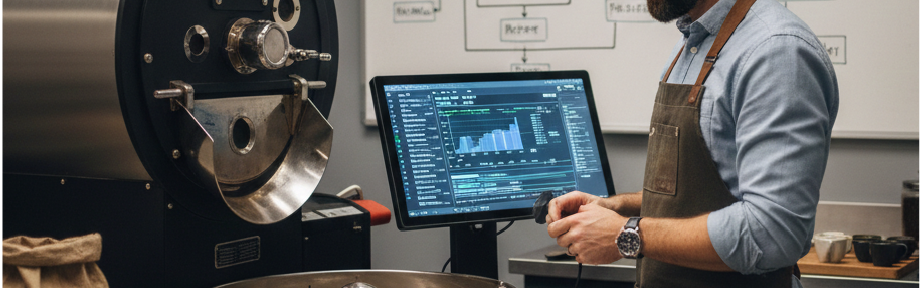
AI can spot patterns. Curves can show signals. Data can reduce guesswork. But none of them can taste. None of them can care. None of them can say “this is ready.”
Coffee still needs judgement, not autopilot.Technology should sharpen decisions, not replace them.
If an AI ever claims “notes of childhood nostalgia,” I am filing a bug.
Where does this leave us ?
I came into coffee thinking I could “tech” my way through it. Build a platform, add data, sprinkle AI, ship.
Coffee politely disagreed.
What I did not expect is how skilled the coffee world already is. People here really know what they are doing. There is serious craft, serious engineering, and a surprising amount of research, from flavour science to processing to tools and brewing. I have been (proudly) impressed, and slightly humbled. Slightly ( see the intro to understand why).
So yes, we will bring systems, structure, and models. Not because coffee needs saving, but because there’s still a gap between all that expertise and the cup most people drink on a normal morning. Our job at Heart of Coffee is to help bridge that gap, so the result feels simple, reliable, and enjoyable for every Joe or Jane out there.
We’ll build this the slow way: cup by cup, roast by roast, learning without pretending we already know.


 English
  French