

Arabica or robusta: what’s the difference?
Arabica and robusta are two coffee species, Coffea arabica and Coffea canephora, not two roasts. Arabica is generally sweeter and more aromatic, with more acidity; robusta is more bitter, with more body and up to about twice the caffeine. Robusta is hardier and cheaper to grow, and most of it goes into instant coffee and everyday blends. Every coffee we sell is arabica.
Two species, not two roasts
Arabica (Coffea arabica) and robusta (Coffea canephora) are two species of the same plant genus, Coffea. They are related: arabica was born from a natural cross between Coffea canephora and another wild species, Coffea eugenioides, several hundred thousand years ago (a 2024 genome study puts it at 350,000 to 610,000 years), and it grew wild in the upland forests of Ethiopia. Each species comes in many varieties: Geisha, Typica, Bourbon and Caturra are all arabicas. Either species can be roasted light or dark. The species is decided on the farm, not in the roastery.
Arabica and robusta side by side
| Arabica | Robusta | |
|---|---|---|
| Species | Coffea arabica | Coffea canephora |
| Native to | Upland forests of Ethiopia | Central and western sub-Saharan Africa |
| Where it is grown | Usually about 1,200–1,500 m in the tropics (from sea level up to 2,800 m); does best at an average of 15–24 °C, with no frost | Hotter, more humid lowlands, typically about 200–800 m |
| Largest producers (2026/27 forecast) | Brazil, Colombia, Ethiopia | Vietnam, Brazil, Indonesia |
| Caffeine (% of the green bean’s dry weight) | About 0.9–1.5% | About 1.2–2.4%, up to about twice arabica |
| Sugars | About 6–9% | About 3–7% |
| Oils (lipids, % of dry weight) | About 12–18% | About 9–13% |
| Taste | Sweeter, more aromatic, more acidity | More bitter and woody, less acidity, more body |
| The plant | Smaller crops, more vulnerable to pests and leaf rust | Bigger crops, hardier, cheaper to produce |
| Share of world production | About 56% (USDA forecast for 2026/27) | About 44% |
| Typical uses | Almost all speciality coffee, and many blends | Instant coffee, everyday blends, traditional Italian espresso blends |
How do they taste?
Arabica is generally sweeter and more aromatic, with more acidity. Almost all speciality coffee is arabica, with its notes of fruit, flowers or chocolate. Robusta tastes more bitter and woodier, with less acidity, less fruit and more body. Part of the difference is already in the green bean: arabica holds more sugar and more oil, robusta more caffeine. The species sets the starting point; the farm, the process and the roast do the rest.
How much caffeine?
Robusta has more. A 2021 review of studies gives about 1.2 to 2.4% of the green bean’s dry weight for robusta, against about 0.9 to 1.5% for arabica; another review puts robusta at about twice arabica. The figures vary with the plant, where it grows and how it is measured. The caffeine in your cup also depends on how much coffee you use and how you brew it.
Why grow robusta at all?
Because it is hardier. Robusta grows in hotter, more humid lowlands, typically between about 200 and 800 m, in places unsuitable for arabica. In the tropics, arabica is usually grown higher, between about 1,200 and 1,500 m, and it cannot survive frost; our own arabicas grow from about 900 m in Jamaica to over 2,000 m in Rwanda. Robusta gives bigger crops and resists pests and diseases better, including coffee leaf rust, which helped it spread in the early 20th century. It is also cheaper to produce. Its share has risen from about a quarter of the world’s coffee in the early 1990s to over 40%: the US Department of Agriculture (USDA) forecasts about 44% for 2026/27. Vietnam and Brazil grow the most.
Robusta in espresso blends
Robusta has a traditional place in Italian espresso blends: good-quality robusta gives them a fuller body and a thicker crema, the foam on top of an espresso. Most robusta, though, is used for instant coffee, and much of the rest goes into everyday blends. According to World Coffee Research, robusta that is carefully grown and processed can also sell on speciality markets. Still, almost all speciality coffee is arabica.
“100% arabica” on a label: what it tells you
That all the coffee in the bag is arabica, with no robusta, and little more. Arabica is more than half of all the coffee grown in the world, so the label says nothing about quality on its own. It does not tell you when the coffee was roasted, or which country, region or farm it comes from. It does not give the variety, the process or how dark the roast is. For that, look for a roast date, a named origin and a process on the bag. Our guide to choosing good coffee beans, below, explains what to check.
Our coffees: all arabica
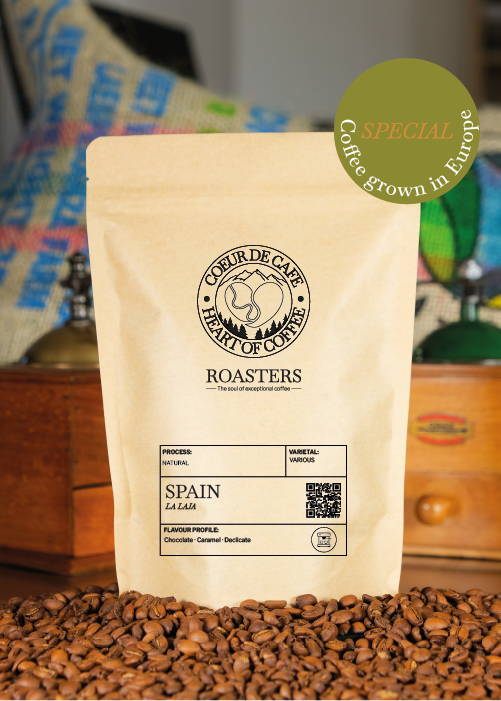
Every coffee we sell is arabica, and our coffee pages list varieties such as Geisha, Typica, Bourbon, Caturra, Catuai, Pacamara and Ethiopian heirloom varieties. Within one species, the range is wide. Ethiopia Djimmah comes from arabica’s homeland: berry and wine-like notes balanced by cocoa. Brazil Fazenda São Francisco is round and chocolatey: milk chocolate, roasted nuts, ripe plum and soft caramel. Colombia Las Margaritas, a Geisha, is all flowers and fruit: lavender, jasmine, orange, starfruit and guava. And Spain La Laja grows at only about 300 m on Gran Canaria, very low for arabica.
In our shop: Our coffees · Ethiopia Djimmah · Brazil Fazenda São Francisco · Colombia Las Margaritas Geisha
Read next: How to choose good coffee beans · Washed vs natural coffee: what’s the difference? · What is the best coffee in the world? · A Short (but Useful) History of Coffee · Is coffee grown in Europe?




 English
 French