

Is coffee grown in Europe?
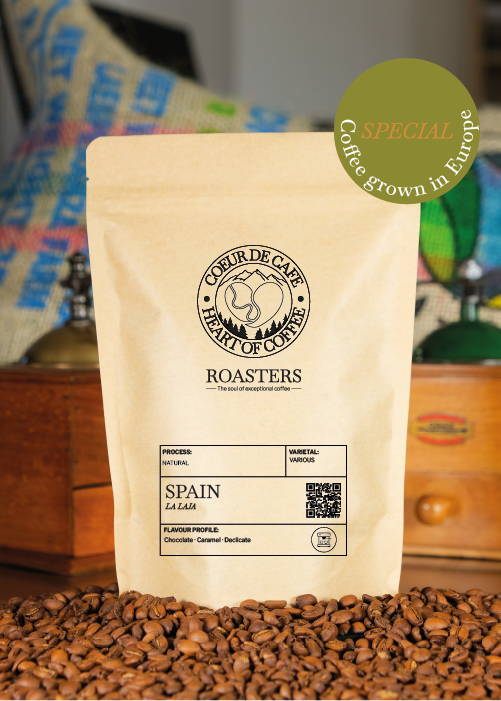
Yes, but only in a few small places. The best known is the Agaete Valley on Gran Canaria, in Spain’s Canary Islands, where coffee has been grown since the 19th century. We sell one of these rare European coffees: Spain La Laja, from Finca La Laja, a natural arabica grown at about 300 m, with gentle chocolate, light fruit and low acidity.
Why does coffee usually grow in the tropics?
Coffee needs warmth all year and cannot survive frost: arabica does best at an average temperature of 15 to 24 °C. That is why nearly all coffee comes from the “coffee belt”, the band between the Tropic of Cancer and the Tropic of Capricorn. There, arabica is usually grown in the mountains, between about 1,200 and 1,500 m, where it stays cool enough. Most of Europe has frosty winters, so coffee can grow outdoors only in a few frost-free corners, and mostly in small amounts.
Gran Canaria, just north of the tropics
Gran Canaria lies at about 28° north, some 500 km north of the Tropic of Cancer. The Canary Islands are in the Atlantic, about 100 km off the north-west coast of Africa at their nearest point. They are Spanish, and part of the European Union, which counts them among its “outermost regions”. Agaete is in the north-west of the island. In its valley, mild temperatures all year, the cooling trade winds and rich volcanic soil let coffee grow only a few hundred metres above the sea: the application for a protected name gives 150 to 550 m.
Coffee in the Agaete Valley since the 19th century
Coffee reached Gran Canaria from Tenerife: Agaete’s first coffee plants are believed to have come from the botanical garden at La Orotava, founded on the orders of King Charles III in 1788 to gather exotic plants. Coffee came to the Agaete Valley in the 19th century, and in 1889 Agaete coffee won a bronze medal at the Paris Universal Exhibition. The valley’s coffee is arabica, traditionally of the old Typica variety, often grown in the shade of fruit trees. Production is tiny: Spanish press reports give between about 1.5 and 5 tonnes a year for the whole valley. In August 2026, the application to register “Café de Agaete” as a Protected Geographical Indication went to the European Commission.
Finca La Laja, our coffee from Gran Canaria
Finca La Laja lies in the heart of the Agaete Valley. With Bodega Los Berrazales, it is a family estate where coffee, vines and tropical fruit are grown by hand, and Víctor Lugo Jorge is the fifth generation of coffee growers in his family. The coffee grows at about 300 m, very low for arabica, in volcanic soil and in the shade of orange, lemon, avocado and mango trees. Only ripe cherries are picked, by hand, then dried whole in the sun: a natural. In the cup: gentle chocolate, light fruit, low acidity and a clean, lingering finish. Volumes are tiny: we sell it in 100 g bags, in our Espresso roast only, as whole beans or ground for your method.
Where else in Europe does coffee grow?
Only in a handful of places, and in small amounts. On São Jorge, in Portugal’s Azores, the microclimate of the Fajã dos Vimes, on the island’s coast, lets coffee grow for local consumption. In mainland Spain, a farm on Granada’s Costa Tropical, near Almuñécar, grows coffee in the subtropical climate of southern Andalusia and offers guided visits. Near Palermo, in Sicily, a family plantation now produces about 100 kg of arabica cherries, just over 15 kg once roasted.
In our shop: Spain La Laja · Espresso coffees
Read next: Best coffee for a moka pot · Best coffee beans for a bean-to-cup machine · Arabica or robusta: what’s the difference? · Washed vs natural coffee: what’s the difference?




 English
 French